
 Hailey Watson
Many women stay in marriages that quietly drain them, not because they are weak, but because they have learned to see painful patterns as just the way things are.
Over time, small signs of emotional disconnection can feel so ordinary that they stop raising red flags.
Recognizing these signs is the first step toward making choices that truly serve your happiness and well-being.
If any of these feel familiar, know that you are not alone and that your feelings are completely valid.
1. Accepting Constant Criticism as Normal
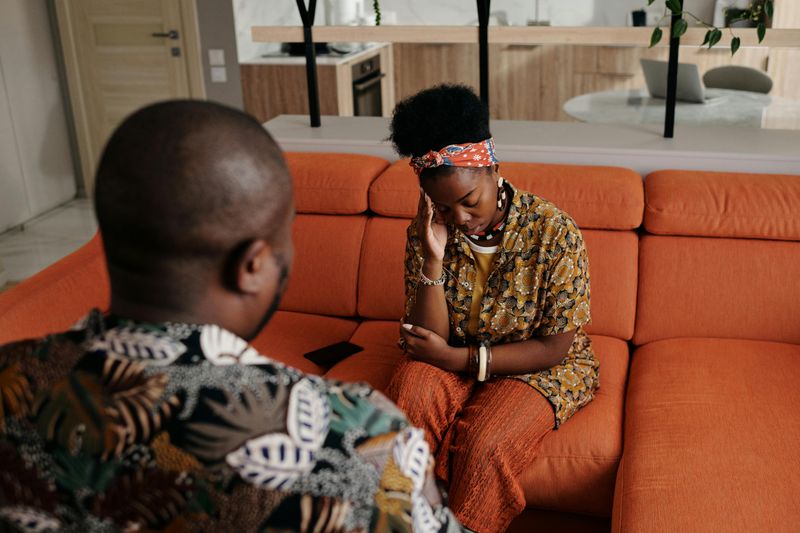
Words have power, and when they are used like weapons every single day, the damage runs deep.
Constant sarcasm, put-downs, or negative comments can slowly wear away a person’s confidence until she barely recognizes herself.
Many women brush this off, telling themselves their partner is just being honest or that is simply how he communicates.
But ongoing criticism is not honesty.
It is emotional harm dressed up as personality.
Healthy relationships include constructive feedback wrapped in respect.
If your stomach tightens every time your partner speaks, that reaction is worth paying attention to.
2. Dismissing the Lack of Affection

Remember when a simple hug from your partner could turn a bad day around?
When that warmth disappears, it leaves behind a quiet kind of loneliness that is hard to explain to anyone on the outside.
Blaming the absence of physical affection on busy schedules or stress is one of the most common ways women avoid confronting a deeper emotional disconnect.
Stress is real, but it rarely kills affection in a loving partnership for years at a time.
Touch is one of the most basic human needs in a relationship.
Its absence over a long period speaks volumes.
3. Staying Together Only for the Children

Putting your children first is admirable, but staying in an empty marriage for their sake can quietly teach them that love looks like silence, distance, and obligation.
Many women convince themselves that keeping the family together at all costs is the right thing to do.
The logic feels selfless, but children are far more perceptive than adults give them credit for.
They feel the tension even when no one speaks about it.
A home filled with two unhappy adults is not automatically better than a home restructured with honesty and care.
Kids thrive when the adults around them are emotionally healthy too.
4. Walking on Eggshells Daily

Spending mental energy calculating every word before speaking is exhausting in a way that is hard to describe.
Yet for many women in loveless marriages, it becomes second nature, like breathing.
When avoiding conflict turns into a full-time job, something has gone seriously wrong.
You should not have to rehearse conversations in your head just to get through dinner without tension filling the room.
This constant state of emotional alertness leads to burnout over time.
A relationship should feel like a safe place to land, not a minefield to navigate every single day.
5. Feeling Like Roommates Instead of Partners

Splitting bills, dividing chores, and maintaining a shared schedule can look like partnership from the outside.
But when there is no emotional warmth underneath the logistics, the relationship starts feeling more like a business arrangement than a marriage.
Many women reach a point where they realize they and their partner are simply coexisting.
Conversations revolve around grocery lists and school pickups, never about feelings, dreams, or genuine connection.
Functional does not mean fulfilling.
A partnership built only on shared responsibilities, with no emotional or romantic thread weaving it together, leaves both people feeling invisible in their own home.
6. Avoiding Important Conversations

There is a certain kind of peace that is not peace at all.
It is just two people agreeing, without ever saying so, to never bring up the things that actually matter.
Difficult conversations get shelved to avoid arguments, and then shelved again, until the unresolved issues pile up like boxes in a storage room nobody wants to open.
Meanwhile, resentment grows in the silence.
Avoiding conflict might feel like keeping the peace, but it is actually choosing slow emotional decay over short-term discomfort.
Real intimacy requires the courage to say the hard things out loud, even when it feels risky.
7. Accepting Emotional Distance

You can share a bed with someone every night and still feel completely alone.
Emotional distance is one of the quietest but most painful signs that a marriage has lost its foundation.
When deep conversations stop happening, when vulnerability feels pointless, and when you stop sharing the things that excite or scare you, the emotional gap becomes a canyon.
Many women normalize this, telling themselves that all long-term relationships eventually get this way.
But closeness does not have to fade with time.
Two people who prioritize connection can maintain it.
Accepting emptiness as inevitable is not wisdom.
It is resignation dressed up as maturity.
8. Tolerating One-Sided Effort

Carrying a relationship on your own shoulders is exhausting, and doing it for years while making excuses for the other person is even more so.
One-sided effort is one of the clearest signs that something is deeply out of balance.
Women often rationalize this dynamic by saying their partner is stressed, busy, or simply not the expressive type.
But effort in a relationship is not about grand gestures.
It is about showing up consistently, day after day.
When the scale tips so far that only one person is investing emotionally, the connection does not just weaken.
It quietly disappears, piece by piece, until almost nothing is left.
9. Pretending Everything Is Fine

Social media highlight reels, cheerful holiday cards, and polished dinner-party conversations can paint a picture of a happy marriage that has nothing to do with what happens behind closed doors.
Many women become so skilled at performing happiness that they start losing track of what they actually feel.
Keeping up appearances becomes a habit, and acknowledging the truth starts to feel like a betrayal of the life they worked so hard to project.
But pretending is not protecting.
It is postponing.
The longer the gap between the public image and the private reality, the harder it becomes to find your way back to honesty.
Comments
Loading…