
 Mary Murphy
Have you ever met someone and instantly felt uneasy, even though they hadn’t done anything obviously wrong?
That gut feeling is more than just imagination — researchers have actually studied what makes people seem creepy.
A landmark study by psychologists Francis McAndrew and Sara Koehnke found that creepiness is often triggered by specific behaviors, physical traits, and social cues.
Understanding these patterns can help you trust your instincts and make smarter decisions about the people around you.
1. They’re More Likely To Be Men

Statistically speaking, men are far more likely to be perceived as creepy than women — and science has a clear explanation for why.
Research by psychologist Francis McAndrew found that study participants almost universally rated men as the creepier gender.
Evolutionary psychologists believe this comes down to threat detection.
Throughout human history, people — especially women — had to stay alert to potential physical or sexual danger from strangers.
That survival instinct is still wired into the brain today.
So when someone triggers that alarm, gender plays a measurable role in how threatening they feel, even before a single word is spoken.
2. They Have Unsettling Or Unusual Jobs

Your job says a lot about you — and some careers send people’s instincts into overdrive.
Clowns, taxidermists, and funeral directors consistently rank among the creepiest professions in psychological surveys, and it’s not hard to understand why.
These jobs involve death, disguise, or unusual environments that most people rarely encounter.
That unfamiliarity creates a kind of mental friction, making it harder to predict how someone in that role might think or behave.
Interestingly, it’s not about the person being dangerous — it’s about the job itself blurring the line between normal and unsettling in the human brain.
3. They Behave In Unpredictable Ways

Nothing triggers a creepy feeling faster than not knowing what someone is going to do next.
When a person’s behavior feels erratic, off-rhythm, or just plain hard to read, the brain goes on high alert trying to figure out their intentions.
Psychologists call this “ambiguity” — and it’s one of the core ingredients of creepiness.
You can’t relax around someone whose next move feels completely unpredictable.
Think about someone who laughs at the wrong moments or stands too close without noticing.
That social mismatch sends a quiet warning signal that something might not be quite right with this person.
4. They Have Unusual Or Unkempt Physical Traits

First impressions are heavily shaped by appearance, and certain physical traits can quietly set off internal alarm bells.
Extremely pale skin, bulging eyes, messy or unwashed hair, and visibly dirty clothing are among the features that people subconsciously associate with something being “off.”
These reactions aren’t about being shallow — they’re rooted in pattern recognition.
The brain constantly scans for deviations from typical social norms as a way to assess safety.
When someone’s appearance breaks too many of those unspoken rules at once, it can feel unsettling even if there’s no logical reason to be concerned.
The body reacts before the mind catches up.
5. They Have Strange Or Unsettling Hobbies

Hobbies reveal a lot about a person’s inner world — and some pastimes raise more eyebrows than others.
Collecting unusual objects, obsessively watching people in public, or maintaining secretive and socially abnormal habits can all contribute to a creepy reputation.
What makes these hobbies unsettling isn’t necessarily the activity itself, but the way they hint at a mindset that operates outside accepted social boundaries.
People feel uneasy when they sense someone’s interests are hidden or hard to explain.
Research confirms that strange hobbies rank high on the list of creepiness triggers.
When curiosity turns inward and secretive, it leaves others feeling genuinely uneasy and uncertain.
6. They Stare A Little Too Long
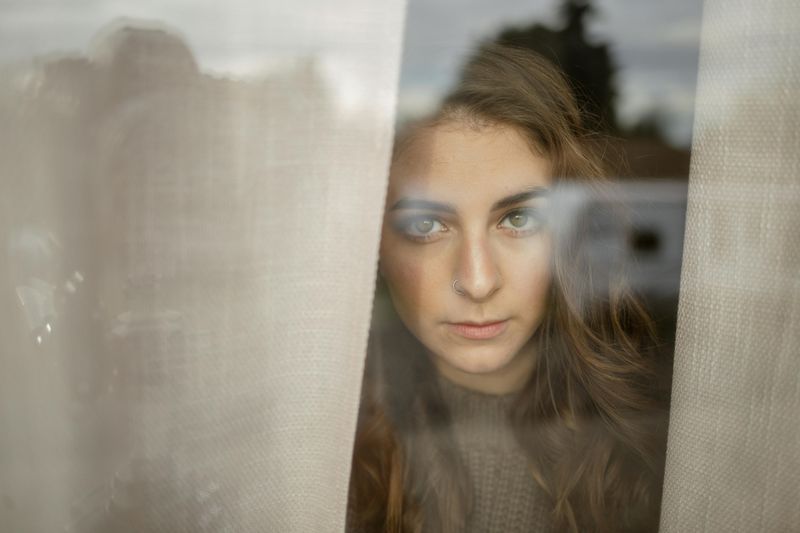
Eye contact is one of the most powerful forms of human communication — but when it goes on too long, it flips from connection to discomfort almost instantly.
Prolonged, unblinking staring can feel like an invasion of personal space, even from across a room.
Humans are extraordinarily sensitive to gaze cues.
Research shows that the brain processes eye contact in a dedicated neural pathway, which is why an unusual stare can feel so physically uncomfortable.
Normal eye contact lasts just a few seconds before breaking away.
When someone holds that gaze past the social norm, it signals a lack of awareness — or worse, an intentional power play.
7. They Linger Around Or Seem To Be Watching People

That slow, creeping feeling of being watched is one of the most universally uncomfortable sensations a person can experience.
When someone lingers nearby without an obvious reason — hovering, observing, or quietly following — the brain treats it as a potential threat worth tracking.
The unsettling part isn’t always what the person does, but what they might do.
That open-ended uncertainty is exactly what makes this behavior so deeply unnerving to most people.
McAndrew’s research specifically highlighted lurking and watching as top creepiness triggers.
The ambiguity of the person’s intentions leaves no safe conclusion to land on, keeping your guard permanently and exhaustingly raised.
Comments
Loading…